


How to Display Portraits and Icons at Home Without Turning It into a Shrine
To display portraits of the people you admire without kitsch, choose one strong image, give it a deep frame and a considered place, and let the rest of the room stay calm.
By Maya Sheinberger | 26.06.26
With a new film about Michael Jackson, a wave of posters has flooded the rooms of people who finished high school long ago. They're not alone. Fandom in home design stopped belonging only to kids a long time ago. In fact, it started well before pop stars, when pictures of rabbis, righteous figures and spiritual leaders began to hang in many homes, sometimes right beside the TV. Between Rabbi Nachman and Justin Bieber, there's a lot we can learn from a habit that has unfairly become a synonym for kitsch.
Key takeaways
One strong portrait says more than a wall of posters.
Large-format photos, deep frames and unexpected angles turn a figure into atmosphere.
Place it in relation to furniture and light, not only in the center of a wall.
A quote or a line of text can carry the same meaning as a face.
Treat spiritual and family figures as art: quality print, simple frame, raw materials around it.
Shrine vs. a home with a story
Shrine | Home with a story |
A whole room of life-size cardboard prints | One large, well-printed photograph |
Posters stuck on with tape | Deep frames and quality paper |
The idol shouting from every wall | A figure that adds mood to one corner |
Heavy, dark bookcases for treasured books | Thin custom shelves that make them a calm focal point |
Ornate objects everywhere | One geometric brass or silver piece on a simple console |
From fandom to cultural collection
All over the world, we see homes that have turned into museums for one person: life-size statues of Prince and Elvis, walls so covered in band posters that not a patch of drywall shows, even bedding printed with Justin Bieber's face. Most of us see these spaces as a campy shrine. Still, a home is much more than walls and furniture. It's our mirror, and some figures or values will always make us smile or feel at home. The step from taped-up posters in a childhood bedroom to icons in an adult home is the distance between blind admiration and conscious cultural collecting. In our 30s and 40s, the need to surround ourselves with people who inspire us, whether The Beatles, Charlie Chaplin and Albert Einstein, or spiritual figures such as Rabbi Nachman of Breslov or the Baba Sali, takes on new meaning. In contemporary design, the figure is no longer an object of worship. It becomes a cultural compass that gives the space depth and personality.

In the RA apartment, a single round black-and-white photograph by photographer Ron Kedmi hangs between the dark kitchen and the dining table. One image, well placed, gives the whole space its character.
It's all about proportion
The secret is to turn the portrait from a visual texture into part of the interior architecture. A room crowded with life-size cardboard prints of your idol isn't design. Instead, focus on large-format photographs, deep framing and artistic angles that step away from the familiar cliché. The figure becomes a mood and a feeling, rather than a subject shouting from the wall.
Scale: choose one large image over many small ones.
Frame: a deep, simple frame in black, oak or metal gives the image presence.
Angle: a profile, a back view or a detail is often more interesting than the famous pose.
Placement: position it in relation to furniture and light. It doesn't have to be symmetrical.
When the portrait is placed well, it no longer tells only who is in the picture. It says something about who lives in the home. For more on choosing art with meaning, see my post on making your home feel unique.
Words can do the same job
The dialogue doesn't have to pass through faces. Signatures and sentences, from a line of a favorite song to a verse from the Song of Songs printed on the wall, add a fascinating layer that speaks to the rest of the home.
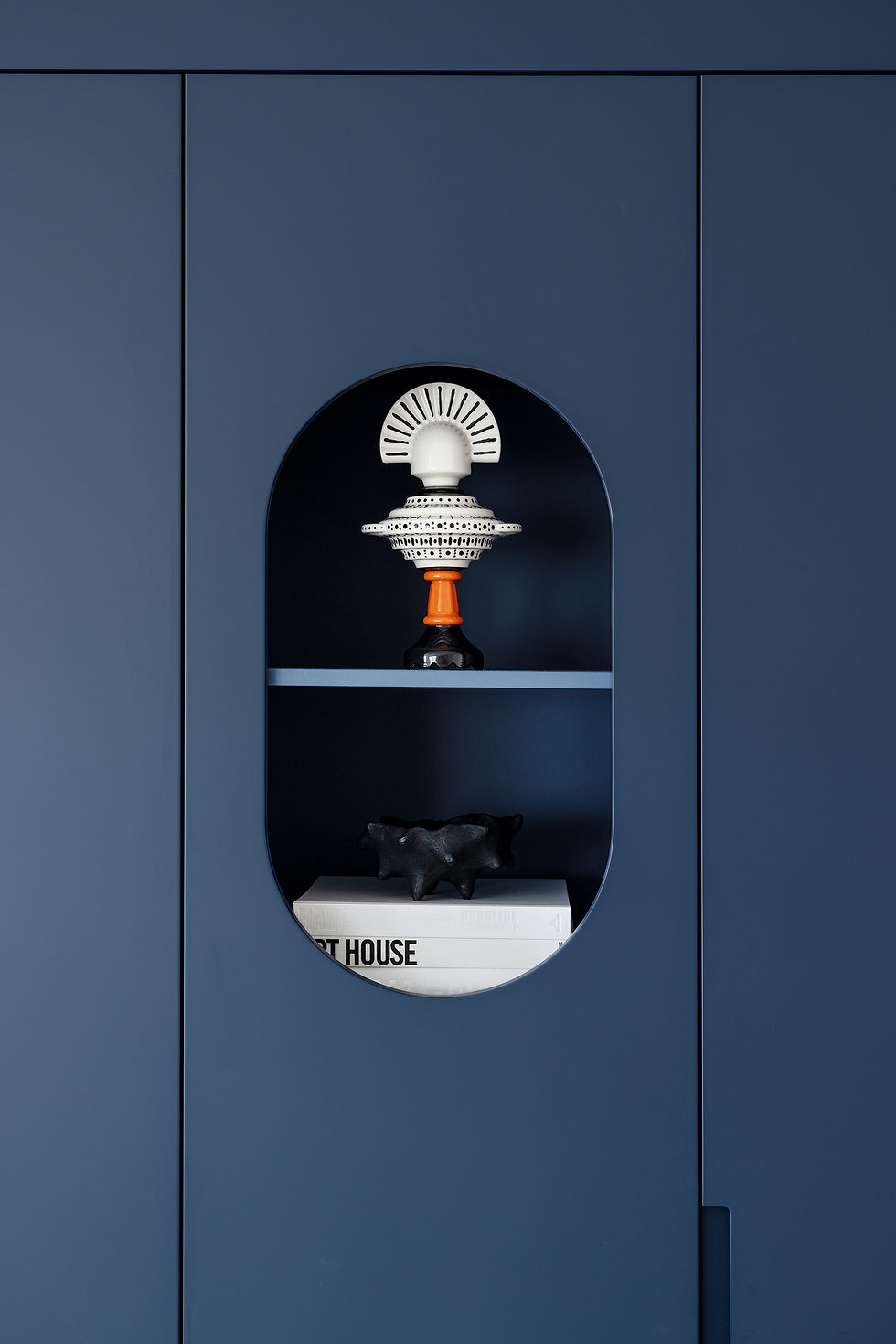
In the YL apartment, an arched niche set into deep blue joinery holds one sculptural piece. A small, framed space like this is a good way to give a meaningful object its own stage.
A private sanctuary
Alongside pop and film idols, many Israeli homes are showing a pull toward roots, faith and identity that crosses communities and definitions. Pictures of rabbis and righteous figures, sometimes seen as belonging to an old or heavy visual world, can look refined when treated as art. A quality black-and-white photograph of a spiritual figure, printed on good paper and framed simply, sits naturally beside raw, honest materials such as concrete, natural wood and iron. The contrast between an ancient figure and a modern frame is what creates interest.
The same goes for a bookcase of holy books. Instead of the heavy library of the past, plan a custom one with thin, minimalist shelves. It lets the books and Judaica become a point of visual quiet, as part of a central feature wall that anchors the living space.

In the M apartment, open black metal shelving above the dining table holds books and personal objects. Thin shelves let the collection read as one calm wall rather than clutter. See also my guide to reducing visual clutter.
Between sacred and everyday
In the end, bringing items with religious or cultural weight into a home is a matter of dosage. A Judaica piece in brass or silver with clean geometric lines, set on a minimalist console, gives a home roots and identity without giving up its contemporary feel. Whether it's the face of a rock legend or of a Torah sage, precise placement turns it from a decorative object into an honest reflection of the people who live there. And yes, you can have Justin Bieber in the bedroom and the Baba Sali in the living room.
Frequently asked questions
How do I display a poster of a celebrity in a grown-up way?
Choose one strong image, print it large on quality paper, and give it a deep, simple frame. Place it where it relates to the furniture and light.
Can religious pictures fit a modern interior?
Yes. A quality black-and-white print in a minimalist frame sits well beside concrete, wood and iron. Treat it as art rather than as an add-on.
How many portraits should I hang in one room?
Usually one or two. A single strong image has more presence than a wall of small prints.
What frame works best for a portrait?
A deep, simple frame in black, natural oak or metal suits most interiors. Avoid ornate frames unless they belong to the piece.
How do I design a bookcase for holy books?
Plan custom shelves with thin profiles and enough depth for the books, and keep some space empty so the wall stays calm.
Want a home in Tel Aviv or central Israel that tells your story? I'd love to hear about your project.
Maya Sheinberger is an interior designer with nearly 20 years of experience. She has run her independent studio since 2012, and it is based in Ramat Gan. She holds a B.Des with honors from the College of Management. Eight of her projects have won Archilovers Best Project awards, her work has appeared in more than 100 publications, and one of her Tel Aviv apartments features in the book The New Minimalist Style.
Photography @itaybenitphotographer · Styling @maya_livnat_harush
This post was inspired by my column on Mako (in Hebrew).


