


Art in a Minimalist Home: How to Choose It, Where to Hang It
In a minimalist home, art works best as one strong piece per wall, hung where the eye already goes: at the end of an axis, above the dining table or on a calm wall that was planned for it. Choose works with a personal story, and keep the background quiet, so the art becomes the room's character.
By Maya Sheinberger | 31.10.26
A minimalist interior doesn't mean empty walls. The opposite: when the architecture is calm, a single work of art can carry the whole room. In my projects, the art often comes from the clients' own lives, and the design makes room for it.
Key takeaways
Hang one strong piece, or one tight pair, per wall instead of many small ones.
Place art at the end of an axis or above the dining table.
Choose works with a story: a gift, a family work, a favorite artist.
Keep the background calm, so the art leads.
Plan the art with the design, not after it.
How do you choose art for a minimalist home?
Choose works that mean something to you. Art in a minimalist home is not decoration that fills a wall. It's a focal point that gives the calm architecture a personal voice. Size, color and placement matter, but the story behind the work matters more.
Where should art hang?
Where the eye already goes. In the RA apartment, a significant work by photographer Ron Kedmi, a black-and-white photograph printed on round Plexiglas, hangs at the end of the kitchen and dining axis.

Above the dining table is another natural place. In the AA apartment, a large abstract painting by artist Yael Margolin hangs in the dining area, beside the round glass table and the terracotta Gubi pendant.

Should art have a personal story?
It's what makes a home feel like yours. In the C apartment in northern Tel Aviv, the dining wall holds artworks the owner received as a gift from the artist.

In MG House in Hod Hasharon, the son's own paintings and prints were framed and hung around the house. In the M apartment, the column between two windows serves as the background for a lithograph by Dan Reisinger from his "Scrolls of Fire" series.
How do you design a background for a collection?
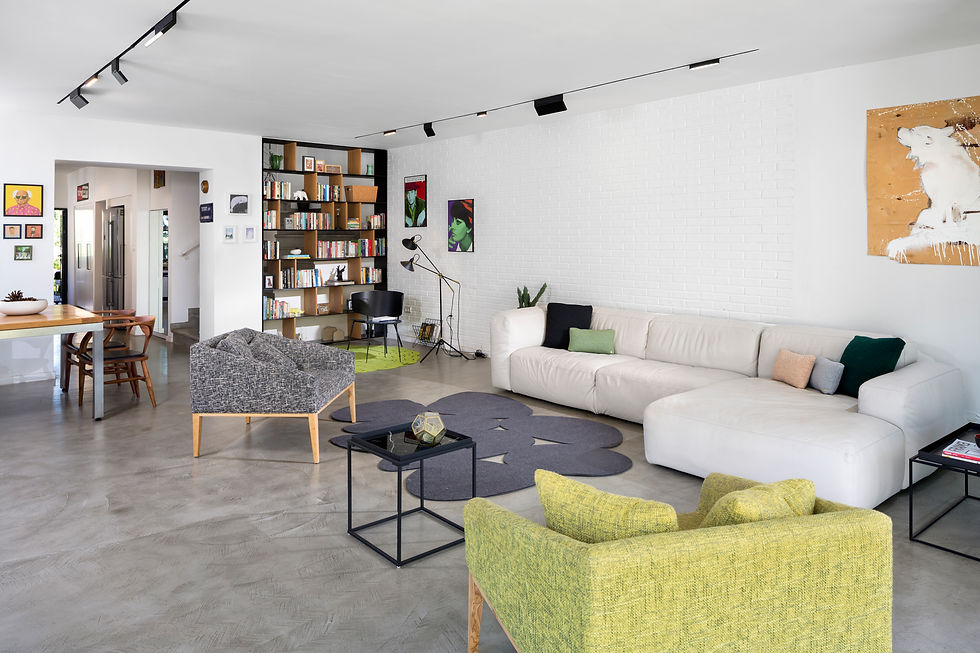
Keep it restrained. In L House in Ramat Gan, white brick, concrete, wood and black metal form a calm architectural backdrop for the family's existing art and collected objects.
In the MH apartment in Ramat Gan, the original stone wall is already a strong texture, so I used geometric, modern patterns around it that add quiet drama without competing with it.

How do you light art?
With adjustable spotlights on a track or recessed in the ceiling, aimed at the work, in the same warm 3000K as the rest of the home. Have a licensed electrician install the track or any new ceiling points. In L House, black track lights and spots were part of the design, so the light can be aimed again whenever a work is moved or replaced. My recommendation is to keep valuable works out of direct sun, which fades paper and photographs, and to avoid glossy glass in front of a work that faces a window. Good light turns a single painting into the focal point of the room in the evening, too.
Art placement at a glance
Home | Where | Work |
RA | End of the kitchen-dining axis | Ron Kedmi, round photograph |
AA | Dining area | Yael Margolin, abstract painting |
C | Dining wall | Works gifted by the artist |
M | Column between the windows | Dan Reisinger lithograph |
MG House | Around the house | The son's paintings and prints |
L House | Living space | The family's existing art |
Frequently asked questions
How high should art hang?
Usually with its center near eye level. Above a table or sofa, keep a short gap so the art and the furniture read together.
Can a minimalist home have colorful art?
Yes. A calm background lets a colorful work stand out, as in AA and L House.
Should I choose the art before or after the design?
If you already own important works, plan the walls for them from the start. More on personal objects in displaying portraits and icons and making your home unique.
How many artworks should a room have?
Fewer than you think. One strong piece per wall usually does more than a crowded gallery.
Want to plan your home around the art you love? I'd love to hear about your project.
Maya Sheinberger is an interior designer with more than 15 years of experience. She founded her independent studio in 2012 and holds a B.Des with honors from the College of Management. Her work has been widely published in Israel and abroad, including eight Archilovers Best Project awards.
Photography @itaybenitphotographer · Styling @maya_livnat_harush (RA, AA, C) · Styling @ofri.paz (MH) · L House: Photography Shai Epstein · Styling @ofri.paz


