


Kids' Room Design: How to Plan a Room That Grows With Your Child
Good kids' room design plans for the child your baby will be in five years, uses deep closed storage for toys, and keeps floor space free for play.
By Maya Sheinberger | 11.07.26
Every new arrival seems to come with a nursery worthy of a European heir. There's a lovely irony here. The only person in the house who isn't on the mortgage, can't tell linen from a kitchen towel and has no opinion on mineral plaster often gets the most planned, most expensive room in the home. Once a baby got a cot, a dresser and a rattle. Today a baby gets a concept, sometimes a mood board, and a pair of exhausted parents muttering "warm Scandinavian" as if it were a diagnosis.
Key takeaways
Plan the room for the next ten years, not for the next ten months.
Place sockets, the desk and the main lighting according to a future furniture layout.
Closed, deep storage matters more than any wallpaper or accessory.
A calm shell lets the child's own color and mess take center stage.
Leave space empty. A good kids' room breathes.
Nursery vs. a room that grows
A room that grows with your child is a children's room planned around future needs, with adjustable storage, flexible wiring and a calm base that décor can change.
Designed for the baby | Designed for the child ahead |
A wardrobe sized for tiny onesies | Adjustable rails and shelves for jeans, coats and costumes |
Sockets where the cot stands today | Sockets planned for a desk, a reading light and chargers |
A themed wallpaper chosen for the photo | A calm base that a new hobby can change in a weekend |
Open baskets for every toy | Deep closed cabinets that swallow the clutter at bedtime |
A room filled to the corners | Floor space left free for play |
From pink and blue to the Pinterest palette
The good news is that the old formula, pink with fairies for a girl and blue with superheroes for a boy, is mostly gone. It was design laziness dressed up as tradition. The less good news is that many parents swapped one uniform for another. Sage, sand, cream, natural wood and smoked terracotta now appear in almost every nursery, and the result can look like a boutique hotel lobby rather than a child's room. A calm palette is a fine starting point. Just remember that the room will soon fill with toys that never passed a brand-palette review, and that's exactly as it should be.

In the YL apartment, the playroom takes its color from play itself: a wall of oversized blocks, a low blue bench and bright storage boxes. The rest of the room stays simple, so the fun has somewhere to land.
How to plan a kids' room years ahead
The biggest mistake in kids' room design is failing to think ahead at the structural level. A smart room doesn't need a contractor every time your child changes size, starts a new grade, or decides that animals are out and football, Roblox or dinosaurs are in.
Wardrobe: choose a wardrobe with movable rails and shelves. A unit for tiny baby clothes should later hold jeans, school bags, coats and an unreasonable number of costumes nobody can throw away.
Sockets: place them according to a future furniture layout, not where the cot happens to stand today. The cot will go, and the tablet charger will arrive.
Desk: plan a spot for a desk from the start, even if for now it only holds a lamp. One day it will hold homework, a water bottle and a pile of clothes.
Lighting: combine general light with a reading lamp near the bed and a light at the desk.
If you're planning a whole home renovation, the same thinking applies to every room. My guide to renovation mistakes to avoid has more questions to ask before you commit.
Closed storage is where design really happens
No textile collection prepares you for the singing neon toys your child will get for their birthday. No calm palette survives a flashing toy car, a psychedelic xylophone and a doll that sings at 6:10 in the morning. This is where real interior design is measured: not in the right wallpaper or the right straw basket, but in closed, deep, well-planned storage that can swallow the color chaos the moment the child falls asleep. Good design doesn't prevent mess. Children are mess in socks. Good design knows where to put it back.
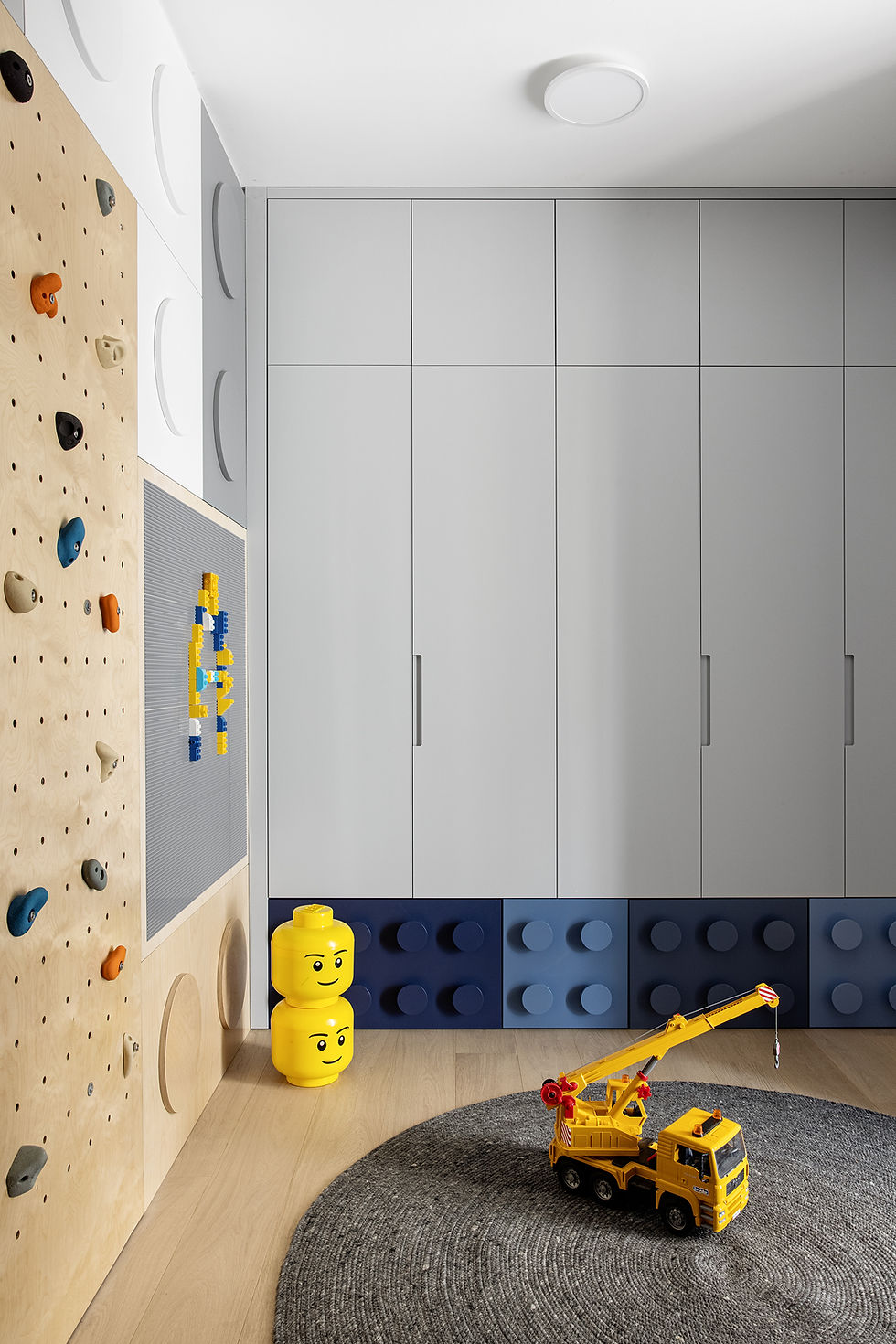
In the same YL playroom, a run of tall closed cabinets sits next to a climbing wall. The toys have a home, the floor stays open, and the room can calm down in a few minutes at the end of the day.
Let the room breathe
On the other side are parents who build a film set: panoramic jungle wallpaper, treehouse beds, museum-grade lighting and a rug that makes you want to take your shoes off. It can be beautiful, as long as it doesn't turn into a trap of impulsive, impractical buying. A good kids' room isn't measured by the number of trendy accessories piled around the cot. It's measured by the room's ability to breathe and to create visual quiet in the middle of all the drama. The same idea works in shared spaces too, as I explain in my guide to a living room with kids.

In the TA apartment, the children's room is built from a few simple parts: a smoky green back wall, white and oak furniture, and a white Roman blind. It's calm, but not precious, and it can easily change as the child does.
Meet the real client
Before planning a room for an older child, I like to meet them and hear about their dreams, favorite colors and hobbies. Their answers often lead to one strong anchor, such as a color, a reading nook or a wall for their drawings, and that anchor makes the room theirs. With babies, the parents decide. Still, it's worth remembering that in the end, the room won't be run by the designer, the parent or Pinterest. It will be run by one small child, armed with a marker and zero respect for the concept.
Frequently asked questions
How do I design a kids' room that grows with my child?
Choose a wardrobe with adjustable rails and shelves, plan sockets and lighting for a future desk and bed position, and keep the base calm so décor can change with new interests.
What is the most common mistake in kids' room design?
Planning only for the baby stage. Rooms designed around a cot often need rebuilding within a few years, when the child needs a desk, more storage and more light.
What storage works best in a kids' room?
Deep closed cabinets with doors work best for toys. Open shelves are good for a few favorite books and objects, but too many open baskets make the room look busy.
Which colors work for a kids' room?
A calm base of white, wood or a soft color works well, with stronger color added through bedding, a rug, art and the toys themselves. It's easier to change these than a painted theme.
Should I involve my child in designing their room?
Yes, from around school age. Ask about favorite colors and hobbies, and let the child choose one or two elements. It helps them feel at home in their room.
Planning a children's room in Tel Aviv or central Israel? I'd love to hear about your project.
Maya Sheinberger is an interior designer with nearly 20 years of experience. She has run her independent studio since 2012, and it is based in Ramat Gan. She holds a B.Des with honors from the College of Management. Eight of her projects have won Archilovers Best Project awards, her work has appeared in more than 100 publications, and one of her Tel Aviv apartments features in the book The New Minimalist Style.
Photography @itaybenitphotographer · Styling @maya_livnat_harush
This post was inspired by my column on Mako (in Hebrew).


